
Visa VAMP Enforcement Is Now Live — Merchants, It’s Go Time
Today isn’t just another day on the calendar. It’s the start of a new enforcement era under Visa’s VAMP program. If your dispute and fraud metrics aren’t locked down, you’re exposed. This article explains what VAMP enforcement really means, how it changes the game for merchants and acquirers, and what urgent steps should happen next.

Visa VAMP Enforcement Is Here: What Happens Now?
As of this morning, Visa isn’t asking nicely anymore.
October 1, 2025, is the day VAMP enforcement begins. It’s no longer a distant deadline, a theoretical risk, or something to deal with “later.” It’s now. And if you’re not compliant, the cost of doing nothing has officially gone up.
For the past six months, Visa’s Acquirer Monitoring Program — better known as VAMP — has been running in advisory mode. No penalties, no fines, just a steady hum of warnings and an opportunity to get your house in order. Some merchants took that opportunity seriously. Others waited. As of today, that grace period is over. Real enforcement has begun, and real money is now on the line.
If your dispute and fraud ratio exceeds Visa’s thresholds, you’re not getting a reminder email. You’re getting enforcement action taken against you.
What VAMP Enforcement Means in Practice
Under VAMP, Visa no longer treats fraud and disputes as separate issues. They now live under one roof. One metric. One threshold. And if you cross it, you risk serious penalties. The formula is straightforward:
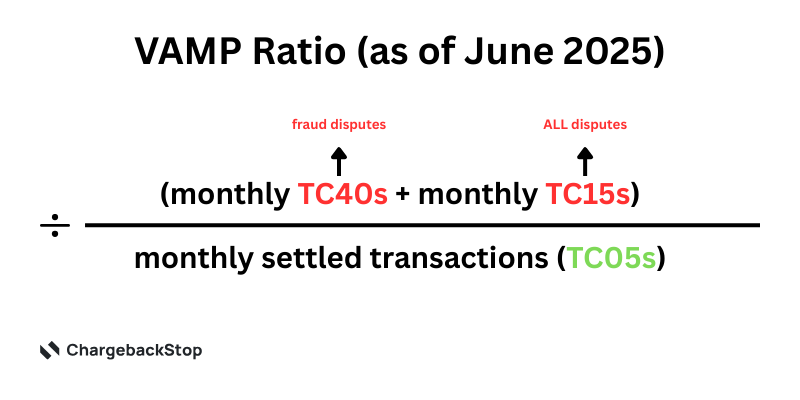
Use our VAMP Ratio Calculator to see where you currently stand in relation to VAMP and whether you’re in or out of compliance.
Visa VAMP Thresholds
Visa published its initial thresholds with the announcement of the new VAMP program. These were revised in May with an effective date of June 1, 2025.
-
Merchants in most regions have an initial threshold of 2.2%, dropping to 1.5% from April 1, 2026. The exception for this is LATAM and Caribbean merchants, whose threshold is already set at 1.5%.
-
Acquirers have slightly different thresholds. The Above Standard threshold is set at 0.5%-0.7%, with anything above 0.7% being classified as Excessive.
These new thresholds only apply to merchants when the total number of fraud transactions and non-fraud disputes is:
- Greater than 1,500 (outside MENA); or
- Greater than 100 and over US$75,000 in value (inside MENA).
Merchants who exceed thresholds will be charged $10 per dispute or transaction reported as fraud. Acquirers will be charged based on their status. Above Standard acquirers will be charged $5 per dispute or transaction reported as fraud from January 1, 2026, while Excessive acquirers are already being charged $10 per dispute or transaction.
Note: For merchants, this is on top of whatever fees your acquirer already tacks on. It doesn’t take long for those fines to snowball.
It’s Not Just Fraud That Counts
One of the biggest changes VAMP brings is that the reason behind a dispute no longer matters. In the old days, fraud and service issues were tracked independently. Under VAMP, they’re lumped together. So whether a customer filed a dispute because of true fraud or because their package arrived late, it still counts.
This is where many merchants will get blindsided. Friendly fraud, late shipments, unclear policies, or poor CX. All of these are now equal offenders in Visa’s eyes. A high rate of “Item Not Received” claims can land you in the same penalty bracket as a compromised payment gateway. Visa doesn’t distinguish between good and bad disputes anymore. It just counts them all together.
Acquirers Are On the Hook, Too
VAMP enforcement applies pressure at two levels: merchant and acquirer. While most of the attention has been on merchants, acquirers are equally in Visa’s sights. If an acquirer’s portfolio exceeds Visa’s thresholds, they get fined too.
And guess what? They’re not going to eat that cost. If you’re a merchant pushing their numbers up, they’ll take action before Visa does.
Some acquirers have already started pre-emptively dropping or repricing high-risk merchants. Others are requiring remediation plans or tighter fraud controls as a condition of keeping accounts active. That trend will only accelerate now that enforcement is live.
If you haven’t already had a conversation with your acquirer about VAMP thresholds, now would be a good time to pick up the phone.
Pre-Chargeback Just Became Essential for Survival
Under VAMP’s new rules, the old mindset of “we’ll deal with the chargeback when it arrives” is straight-up dangerous.
Every dispute that hits the Visa network now carries a fixed financial penalty, regardless of who was right or what the customer’s issue was. It doesn’t matter if the product was delivered, if the fraud was synthetic, or if the chargeback was totally baseless. If it lands in Visa’s system, you’re paying for it both in terms of fees and elevated ratios that can jeopardize your entire processing relationship.
That’s why pre-chargeback resolution is no longer a nice-to-have. It’s your first and only real line of defense and, for acquirers and merchants in sectors with high chargeback volumes, essential for survival.
Visa has made it clear that if you resolve a dispute before it becomes a formal chargeback, it doesn’t count against your VAMP ratio.
So, while VAMP significantly compresses your margin for error — every unnecessary dispute posted to the network is a measurable step towards enforcement action — using pre-chargeback to proactively resolve disputes before they become chargebacks reduces your risk exposure.
Enter ChargebackStop: Your Go-To for Dispute Prevention
ChargebackStop was built for this moment. Our platform combines real-time alert ingestion with automated resolution logic that acts within seconds, not days. That means fewer chargebacks. Lower VAMP ratios. And ultimately, protection from the enforcement squeeze that Visa just switched on.
Merchants using ChargebackStop typically reduce their dispute rates by up to 95% but more importantly, they stay out of the red. They avoid fines, keep acquirers happy, and preserve the processing privileges that keep their businesses running.
VAMP is now live. The only question is whether your dispute operations are ready for it. If you’re not sure, or if you know they’re not, let’s fix that.
Book a demo with ChargebackStop and get compliant before you’re caught out.
Chargebacks are a tax on growth
Most teams only count fees. The real cost is lost revenue, ops time & processor risk. Run your numbers instantly.
Avg. Number of Chargebacks per Month:
Avg. Transaction Value:
Start preventing & winning chargebacks.
Get a demo of our comprehensive chargeback management platform.
Book a demo