
Card Networks
The Merchants' Guide to Visa, Mastercard, AmEx, and Discover
The complete, go-to guide for everything merchants need to know about card network rules, dispute deadlines, and chargeback compliance in 2026.
Card Networks in 30 Seconds
Card networks sit beneath every payment you accept. Visa, Mastercard, American Express, and Discover each set their own fees, dispute timelines, fraud liability rules, and compliance thresholds — and every merchant who accepts cards operates inside those rules, whether they know it or not.
This page breaks down how each network works, where the rules differ, and what those differences mean operationally. It covers interchange and fees, how disputes move through each network, the monitoring programmes that penalise merchants with high chargeback rates, and the pre-dispute tools that let you resolve cases before they hit your ratio.
If you're trying to understand why your chargeback deadlines aren't all the same, why your AmEx disputes feel different from your Visa ones, or how to stay out of network monitoring programmes, this is your starting point.
Top Resources in Card Networks
What Is a Card Network (and Why Should Merchants Care)?
The card networks — Visa, Mastercard, American Express, and Discover — are the infrastructure that makes card payments possible. And guess what? They set the rules that govern how money moves between the customer's bank and yours, what happens when a payment goes wrong, and how disputes are handled when a customer and merchant can't agree.
None of this is negotiable when you're playing in their sandbox. Every merchant who accepts card payments operates inside those rules, whether they know it or not. This has a huge impact on merchants because their rules determine your fees, your fraud liability, how long you have to respond to a dispute, and what happens to your ability to process payments if your chargeback rate gets too high.
Most merchants interact with card networks indirectly, through their payment service provider or acquirer. That layer of abstraction is convenient, but it can obscure the fact that it's ultimately network rules that govern your processing relationship, not your PSP's product terms. Therefore, understanding how each network works — and where they differ — is the foundation of sound payment operations.
Issuers vs Acquirers vs Networks: What's the Difference?
Every chargeback has three moving parts:
- The issuer: This is the customer's bank. It accepts the dispute, assigns the reason code, and decides whether to uphold or reverse your representment.
- The acquirer: This is your bank or processor. It submits transactions into the network, receives chargebacks on your behalf, and is accountable to the network for your dispute performance.
- The network: They set the dispute categories, response deadlines, monitoring thresholds, and, crucially, the penalties which you want to avoid at all costs.
When chargeback ratios rise, it's your acquirer who comes calling, but they're only enforcing the rules that are imposed by the card network.
How Do Issuers and Acquirers Differ?
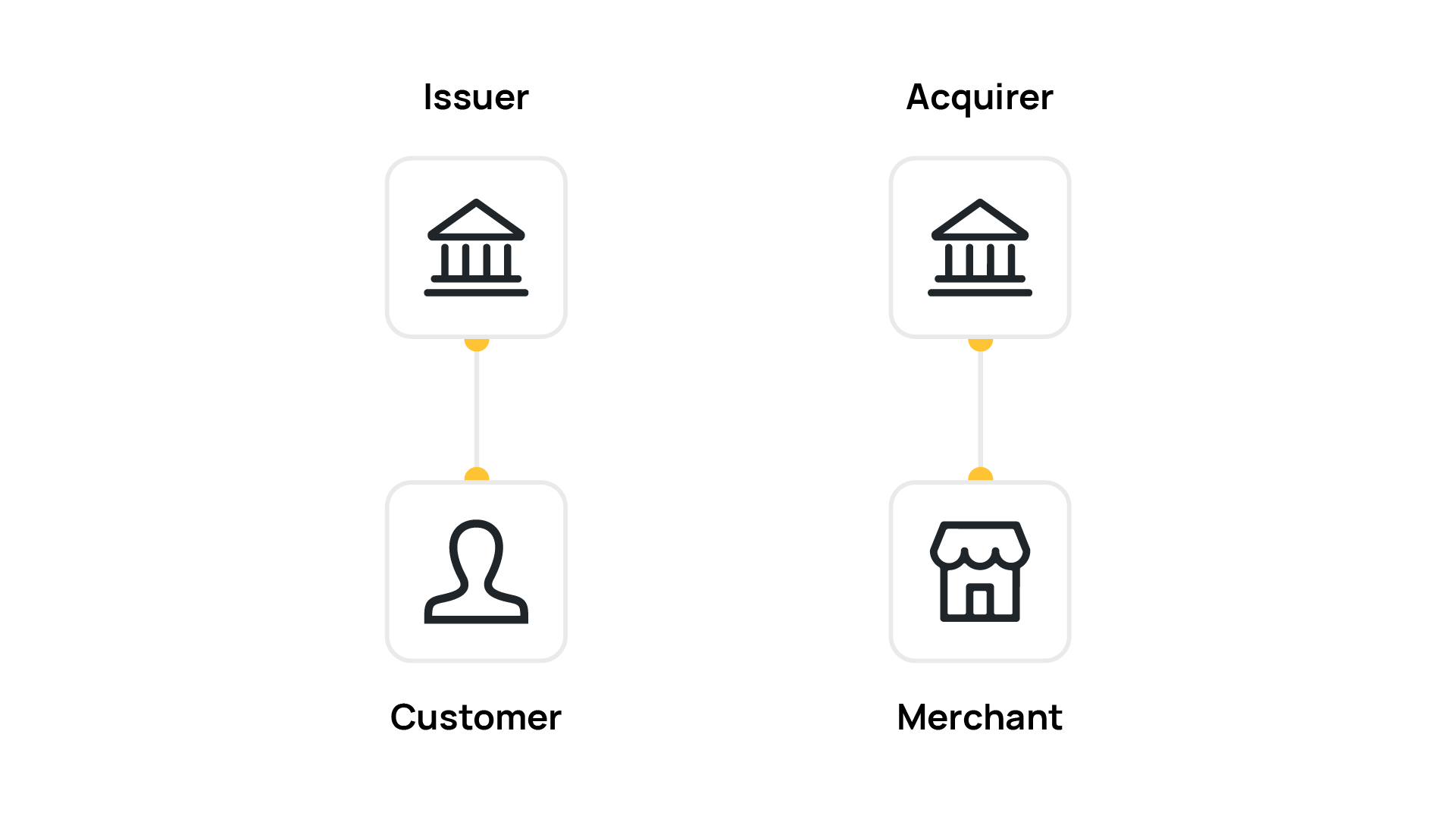
The issuer sits on the cardholder's side and is the party that initially receives the dispute, whereas the acquirer is the merchant's bank or payment processor that submits transactions into the network.
How Card Payments Work: The Four-Party Model Explained
Visa, Mastercard, and Discover all operate what's known as a four-party model. The four parties are the cardholder, the issuing bank (which holds the cardholder's account), the acquiring bank (which holds your merchant account and processes payments on your behalf), and the network itself.
In this structure, the card network sits in the middle as the rule-setter and message router. It doesn't hold anyone's funds directly. When a cardholder pays you, the transaction flows from the cardholder's bank through the network to your acquirer, with the network collecting scheme and processing fees along the way. When a dispute arises, the network again provides the framework — the reason codes, timelines, and arbitration process — within which issuers and acquirers operate.
This is why you never "deal with Visa" directly in most scenarios. Instead, you deal with your acquirer, who deals with the issuer, and the whole exchange follows Visa's rules. Your PSP or payment processor typically handles that acquirer relationship on your behalf.
American Express Works Differently
American Express operates a three-party or closed-loop model. Rather than routing transactions between separate issuing and acquiring banks, AmEx acts as the issuer, network, and acquirer simultaneously. The cardholder banks with AmEx, and — for directly-enrolled merchants — you settle with AmEx. The network is, in effect, a single vertically integrated entity.
In practice, this means AmEx has more direct visibility into both sides of every transaction, which influences how it prices its network, structures its disputes, and communicates with merchants. Through its OptBlue programme, American Express also allows participating PSPs and merchant services providers to onboard merchants on AmEx's behalf, which is how most smaller merchants now access AmEx acceptance without a direct relationship.
The closed-loop model also explains why AmEx's dispute response window is shorter than Visa's or Mastercard's, and why evidence requirements sometimes reflect AmEx's greater internal data access. These differences are covered in detail in the AmEx section below.
What is Chargeback Prevention?
Chargeback prevention is a catch-all term for everything a merchant does to stop disputes from turning into chargebacks. It's not a single tool or program, but the set of processes that sit between a customer's problem and a chargeback.
Visa vs. Mastercard vs. AmEx vs. Discover: Key Differences for Merchants
The table below summarises the key operational differences across all four networks. The sections that follow unpack each one in more detail, but this overview is a useful reference point when comparing dispute timelines, tooling, and programme names side by side.
A few things worth noting before diving in. The 120-day dispute initiation window appears across all four networks, but the anchor date shifts: Visa typically counts from the expected delivery date for goods disputes, while other conditions use the transaction processing date. That distinction catches merchants out when they assume a 120-day window means the same thing regardless of what the dispute is about.
Response windows matter enormously, too. Mastercard's 45-day representment window is anchored to the chargeback settlement date, not the date you receive the notification — a difference that can cost you several days of the window if your notification flow isn't tight.
AmEx's 20-day window is materially shorter than any other network and requires disputes to be picked up and actioned quickly. Most PSPs also impose internal deadlines earlier than the network maximums, so always confirm what your processor's effective deadline is, not just the network's published limit.
Fees, Interchange, and What Merchants Actually Pay
Card network fees are layered, and most merchants never see the full picture. What typically shows up on a merchant statement as a single rate (i.e., the merchant service charge) is actually a stack of several distinct components, each controlled by different parties.
Interchange fees are the base charges. These are set by the card networks, paid by the merchant's acquirer to the cardholder's issuing bank, and passed through to merchants as a cost. They vary significantly based on card type (debit, credit, rewards, corporate), the merchant's category code, how the transaction was authenticated, and whether the transaction was card-present or card-not-present. Interchange is non-negotiable for individual merchants, and the rates are published by the networks and applied uniformly.
On top of interchange sit scheme and processing fees, also set by the networks, which fund the network's own infrastructure, fraud tools, and compliance programmes. These are assessed per transaction and, in some cases, per dispute. Above that layer sits the acquirer's margin, which is effectively the spread between what the acquirer pays out in interchange and scheme fees and what it charges you as the merchant. This is where negotiation is actually possible, particularly for merchants with high volume or favourable risk profiles.
Can Merchants Reduce Their Card Processing Fees?
Interchange rates respond to a handful of merchant-controlled inputs, even if the rates themselves are network-set.
Authentication is one of them: transactions authenticated via EMV 3DS can attract lower interchange in some categories because the liability shift reduces issuer risk. Fraud rates feed into processing tier assessments over time. Accurate MCC classification matters because interchange categories are built around it, and a miscoded merchant category can result in consistently higher fees than the correct rate would produce.
Where merchants have no influence is in negotiating scheme headline rates or getting network-level exemptions from published interchange tables. What's worth pursuing instead is maintaining low fraud and chargeback rates, because these feed into the risk-based pricing decisions that acquirers do have discretion over.
How Disputes Work Across Card Networks
Regardless of which network is involved, the dispute lifecycle follows a broadly similar structure. A cardholder contacts their bank, and the issuer reviews the claim and decides whether it has merit under the applicable network framework. If it does, the issuer initiates a chargeback, reversing funds from your account and applying a fee. You then have a defined window in which to accept the loss or contest it with evidence.
What varies across networks is everything inside that structure: The reason code, the terminology at each stage, the timelines, the evidence requirements, and the arbitration process that applies if both sides disagree after the first exchange.
It's also worth being clear about what "dispute" and "chargeback" mean in this context:
- A dispute begins when the cardholder contacts their issuer, but the bank hasn't reversed anything yet.
- A chargeback is the formal reversal of funds.
These are different points in the same process, and the distinction is important because the cheapest resolution — a refund or cancellation — is only available in the pre-chargeback window. Once a chargeback has been filed with the network, it counts against your ratio even if you later win the representment.
How Long Do You Have to Respond to a Chargeback?
The 120-day dispute window that appears across all four networks is deceptively uniform. The anchor date shifts depending on the dispute condition, and the condition is determined by the reason code.
For a "merchandise not received" dispute under Visa, the 120 days can run from the expected delivery date (not the transaction date!) which means disputes can surface significantly later than merchants expect. A transaction processed in January with a promised March delivery could generate a dispute as late as July.
Reason codes also dictate which network rules apply at each stage. Networks publish separate operating regulations that define, for each reason code, the acceptable evidence, the stage structure, and any exceptions. A chargeback specialist working on a Mastercard "Cardholder Does Not Agree" dispute operates under different rules than one handling a Visa "Compelling Evidence" case. Treating all disputes as interchangeable is one of the more reliable ways to miss representment deadlines or submit evidence that doesn't address the actual claim.
Operationally, the safest approach is to build your internal processes around the shortest plausible deadline, which is your PSP's internal cutoff, and treat network maximums as the maximum ceiling rather than a working timeline.
Stopping a Dispute Before It Becomes a Chargeback
All four networks have mechanisms that allow disputes to be resolved before they become chargebacks, though coverage and process vary.
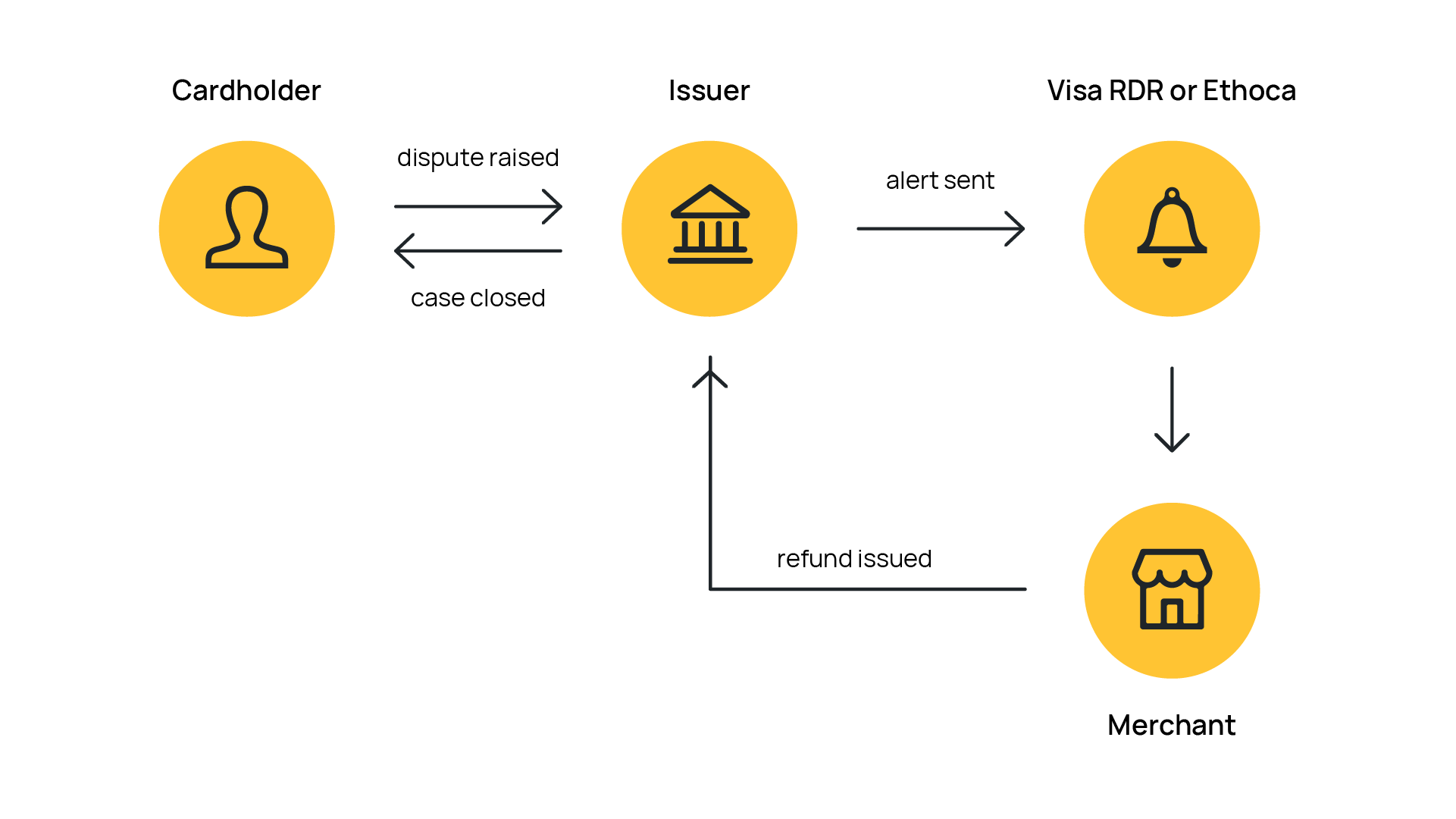
Visa operates the Rapid Dispute Resolution programme (RDR) through Verifi, which lets merchants configure automated resolution rules that apply when a cardholder raises a dispute with a participating issuer. Mastercard operates Ethoca Alerts, which notify merchants or their service providers when a dispute is initiated, giving a short window to respond — typically with a refund — before the chargeback is filed.
These tools are accessed through acquirers, PSPs, or authorised resellers, not directly from Visa or Mastercard. The practical implication is that your ability to use them depends on whether your payment infrastructure supports them, and on ensuring you are enrolled through an authorised channel. Merchants who access Ethoca Alerts or Verifi RDR through a provider that is not an authorised reseller may find coverage gaps or compliance issues that undermine the benefit.
Resolving disputes at the pre-chargeback stage is categorically better for your ratio than winning a representment. Even a successful representment represents a chargeback event that has already been recorded against your MID. Prevention at the alert stage removes the event entirely.
Visa Chargeback Rules and Dispute Process
How Does Visa Work for Merchants?
Visa operates as a four-party open-loop network. Merchants access Visa acceptance through their acquirer, who in turn is certified by Visa and responsible for merchant compliance with Visa's operating regulations. Payment service providers — Stripe, Adyen, and others — typically hold their own acquiring licences or operate under a licensed acquirer's umbrella, and merchants onboarded through these PSPs inherit that compliance framework.
Visa's merchant-facing dispute tooling sits within Visa Resolve Online (VROL), which is the case management platform your acquirer or PSP uses to manage disputes. Merchants typically access this via their PSP's dashboard or a middleware layer rather than VROL directly. For pre-dispute tooling, Visa operates Order Insight (transaction data sharing) and Rapid Dispute Resolution (RDR) through its Verifi subsidiary. Both are accessed through authorised resellers like ChargebackStop or directly through Verifi's merchant onboarding pathway.

Visa Chargeback Deadlines: How Long Do You Have to Respond?
Visa disputes follow Visa's Core Rules and Product and Service Rules, which set out the timelines for each stage. The cardholder has up to 120 days to initiate a dispute in most conditions, measured from the transaction processing date or, for "merchandise not received" disputes, from the expected delivery date specified at checkout. If no delivery date was communicated, Visa typically counts 30 days from the transaction date. Unfortunately, this creates exposure for merchants in categories where fulfilment is slow.
Once a chargeback has been issued to your acquirer, you generally have 30 calendar days from the dispute processing date to submit a representment. Your acquirer or PSP will impose its own internal deadline (usually several days earlier) to allow time for submission processing. Working from the date you receive the chargeback notification is not sufficient; work from the processing date shown in the chargeback record.
Examples of some Visa reason codes and their associated merchant deadlines include:
- Reason Code 13.1: Merchandise/Services Not Received — 30 days to respond
- Reason Code 10.1: Counterfeit Fraud — 30 days to respond
- Reason Code 34: Legal Process Request — 30 days to respond
Visa also has a pre-arbitration stage that allows both parties one further exchange after representment before the case goes to binding network arbitration. Pre-arbitration has its own 30-day window from the pre-arbitration processing date. Arbitration fees run into hundreds of dollars per case and are typically avoided unless the dispute value clearly justifies the cost.
How Visa Secure and 3DS Affect Your Chargeback Liability
Visa's authentication programme is Visa Secure, which implements EMV 3DS (3DS2). When a transaction is authenticated through Visa Secure and a chargeback is filed under a fraud or authorisation dispute type, liability shifts from the merchant to the issuer, provided the issuer also participates in 3DS. This is one of the more direct financial incentives for deploying 3DS on card-not-present transactions.
The liability shift is not blanket coverage, as it applies specifically to fraud and authorisation dispute types. Non-fraud disputes such as "merchandise not received," "goods not as described," and processing errors are unaffected by 3DS authentication. Merchants who assume that 3DS protects them from all chargebacks tend to be surprised when disputes in fulfilment-related categories continue arriving despite high authentication rates.
Visa's Stored Credential Transaction Framework governs recurring billing and card-on-file transactions and requires merchants to correctly identify the initial transaction (cardholder-initiated) and subsequent transactions (merchant-initiated) using the right indicators, and to maintain a stored credential agreement. Incorrect indicators are one of the more common dispute triggers and are an easy compliance fix once identified.
Visa VAMP: What Triggers It and How to Stay Out of It
Visa's chargeback monitoring framework is the Visa Acquirer Monitoring Program (VAMP), which came into force in April 2025 when it replaced the Visa Dispute Monitoring Program (VDMP) and Visa Fraud Monitoring Program (VFMP). VAMP consolidates dispute and fraud monitoring into a single ratio — the VAMP ratio — which is calculated at the acquirer level and broken down by merchant.
Merchants whose dispute volumes push their acquirer's VAMP ratio above Visa's thresholds become subject to the programme's requirements, which include remediation plans, reporting obligations, and financial assessments if the situation persists.
Acquirers bear formal responsibility for VAMP compliance, which means they have strong incentive to identify and address merchants who are contributing disproportionately to the portfolio's ratio. That scrutiny can come quickly and without much warning from the merchant's side.
Mastercard Chargeback Rules and Dispute Process
How Does Mastercard Work for Merchants?
Mastercard operates the same four-party open-loop model as Visa. Merchants access Mastercard acceptance through acquirers and PSPs, who are responsible for compliance with Mastercard's transaction processing rules. From a merchant's day-to-day perspective, Mastercard and Visa acceptance are handled through the same acquiring relationship, though the underlying rule sets differ at the operational level.
Mastercard's pre-dispute tooling is delivered through Ethoca, which Mastercard acquired in 2019. Ethoca Alerts notify merchants or their providers when a dispute is initiated at a participating issuer, creating a window to resolve the issue before the chargeback is filed. Participation requires enrollment through Mastercard, an authorised reseller like ChargebackStop, or a participating service provider.
How Long Do You Have to Respond to a Mastercard Chargeback?
Mastercard's representment window is 45 calendar days from the chargeback settlement date. Note: This is not the date you receive the notification, and not the date the chargeback was initiated.
This is one of the most common errors in Mastercard dispute management. PSPs and acquirers typically display the notification date prominently and may not display the settlement date clearly. If your team is working from the notification date, cross-check it against the settlement date in the chargeback detail record and rebuild your deadline from there.
Mastercard's pre-arbitration stage (called "second presentment" in its operating rules) follows similar logic to Visa's, with a subsequent arbitration option available if the pre-arbitration exchange doesn't resolve the case. Mastercard arbitration fees are comparable to Visa's and similarly represent a threshold above which fighting disputes becomes economically irrational for most case values.
What is Settlement?
Settlement is when chargeback funds were formally moved between banks. These dates can be several days apart, and the difference matters because a merchant who starts counting from notification receipt may find they have less time than they assumed.
Does Mastercard 3DS Protect Merchants from Chargebacks?
Mastercard's 3DS programme is Mastercard Identity Check, which also implements EMV 3DS2. The liability shift mechanics mirror Visa's: successful authentication through Identity Check shifts fraud and authorisation dispute liability to the issuer, with the same caveats about the shift not applying to non-fraud dispute categories.
Mastercard's tokenisation platform is the Mastercard Digital Enablement Service (MDES). Network tokens generated through MDES replace card credentials in transaction data, reducing fraud exposure for stored card credentials and enabling better issuer-side fraud decisioning. Most merchants access MDES tokenisation through their PSP or gateway, which handles MDES participation on their behalf. Direct MDES integration is available for larger merchants and marketplaces with the technical capacity to manage it.
Mastercard ECM and HECM
Mastercard's chargeback monitoring operates through the Excessive Chargeback Programme (ECP). The programme has two tiers:Excessive Chargeback Merchant (ECM) andHigh Excessive Chargeback Merchant (HECM).
- ECM represents the initial compliance threshold where merchants are flagged when their Mastercard chargeback rate exceeds the programme's limits and are required to remediate with acquirer oversight.
- HECM is the escalation tier for merchants whose rates remain elevated or continue to worsen.
The step from ECM to HECM is a serious escalation because reporting requirements intensify, financial assessments grow, and acquirers are under explicit network pressure to resolve or exit the relationship.
Merchants in HECM are under active scrutiny from Mastercard directly, not just their acquirer, and the only path out of either tier requires sustained ratio reduction over several consecutive monitoring periods. That's why prevention at scale, rather than just winning individual representments, is the more reliable route back to compliance.
Mastercard's ratio calculations use a settlement-date-based methodology, which aligns with the chargeback representment window anchoring described above. Acquirers operationalise the programme thresholds independently, and exact trigger levels should always be confirmed with your acquirer rather than relied upon from secondary sources, as programme details can be updated between network bulletins.
American Express Chargeback Rules and Dispute Process
What Is AmEx OptBlue?
American Express's closed-loop model creates a fundamentally different operational relationship for merchants. Where Visa and Mastercard connect separate issuing and acquiring institutions through the network, AmEx controls the full stack. For merchants with direct AmEx agreements, AmEx is both the network and the entity you settle with; there's no separate acquiring bank in the traditional sense.
For merchants who access AmEx acceptance through OptBlue, a PSP or merchant services provider handles the relationship on AmEx's behalf. OptBlue allows participating providers to bundle AmEx acceptance into their merchant agreements, extending AmEx to merchants who would otherwise not qualify for or seek a direct relationship. For most smaller and mid-market merchants, OptBlue via their existing PSP is how they accept AmEx.
The consequence of the closed-loop model is that AmEx has a richer view of each transaction than open-loop networks typically do. It sees both the cardholder's account data and the merchant's processing history, which informs both its fraud decisioning and its dispute process. This integration is also what allows AmEx to manage disputes with fewer intermediary steps, but it also means the merchant has less time in the response process.
Why the 20-Day Window Changes Everything
The 20-day representment window is the most significant difference between AmEx and the other major networks.
Merchants have 20 calendar days from the chargeback date to submit a response. Given that AmEx disputes can surface across multiple processing systems and notification channels, and that evidence assembly takes time, 20 days is a genuinely tight window for teams that aren't set up to move quickly.
This means that AmEx dispute management requires faster triage than Visa or Mastercard. If you're prioritising which disputes to contest based on case value or win probability, you need to make that assessment and get responses submitted within the same timeframe that Mastercard would give you for a fraction of the decision.
The cardholder's initiation window is up to 120 days from the transaction date in most dispute conditions. AmEx notifies merchants of chargebacks through its American Express Merchant Services portal, and disputes must be managed through that system or via your PSP if you're an OptBlue merchant.
How AmEx SafeKey and 3DS Affect Chargeback Liability
AmEx's 3DS programme is SafeKey, which implements EMV 3DS2. The liability shift mechanics for SafeKey align broadly with Visa Secure and Mastercard Identity Check: fraud and authorisation disputes where SafeKey authentication was completed shift liability to AmEx as the issuer.
The closed-loop structure means AmEx is simultaneously the 3DS provider, the issuer making the authentication decision, and the entity absorbing liability on successful shifts. This makes AmEx's authentication data and issuer behaviour somewhat different in practice from what merchants experience in open-loop networks.
SafeKey coverage in the UK and EU is also subject to Strong Customer Authentication (SCA) requirements under PSD2, meaning that many consumer card-not-present transactions in regulated markets require authentication regardless of merchant preference.
American Express Rules for Subscription Merchants
American Express has explicit requirements for merchants operating subscription and recurring billing models, and these are more detailed than what Visa and Mastercard publish.
AmEx's merchant regulations require that for recurring billing arrangements merchants must:
- clearly disclose the material terms of the subscription at checkout, including the billing amount and frequency;
- obtain explicit cardholder consent and retain evidence of that consent;
- provide simple, accessible cancellation processes; and
- include recurring billing indicators correctly in transaction data.
Disputes in the subscription category are disproportionately common for AmEx, partly because AmEx cardholders tend to be more engaged with their statements and more likely to dispute transactions they don't recognise. A subscription that billed correctly but without a clear renewal reminder is a recurring dispute trigger. Getting the disclosure, consent capture, and billing indicator right reduces the surface area for these cases substantially.
How Discover Disputes Work: Deadlines, Rules, and Key Differences
How Does Discover Work for Merchants?
Discover operates as an open-loop network in the four-party model. Its network brands include Discover (primarily US), Diners Club International (international acceptance), and PULSE (debit network). For most international merchants and many US merchants outside of direct relationships, Discover acceptance is managed through their acquirer or PSP, which handles Discover Network Dispute System (DNDS) interactions on the merchant's behalf.
Discover's acceptance rate is smaller than Visa's or Mastercard's, particularly outside North America, but it's a standard inclusion in most merchant agreements in the US market. For merchants in other regions where Discover's volume is negligible, the dispute and compliance operational overhead is proportionally lower, though the same network rules apply to any transaction that does occur.
How Long Do You Have to Respond to a Discover Chargeback?
Discover's dispute initiation window broadly aligns with other networks at up to 120 days in most conditions, though exact trigger points for individual reason codes should be confirmed in Discover's operating regulations or with your acquirer.
The pre-arbitration inquiry response window is 20 calendar days, and the issuer has a 30-day window from dispute initiation to submit a pre-arbitration inquiry — the stage at which the dispute formally escalates toward chargeback territory.
Discover disputes are managed through the DNDS portal, and for merchants whose PSP handles this on their behalf, it's worth understanding what visibility you have into individual case timelines. The 20-day response window applies once a pre-arbitration inquiry has been submitted, and if your notification flow from PSP to the internal team has any delays, those days disappear quickly. Confirming live deadlines inside DNDS or your PSP portal is more reliable than relying on published network guidelines alone, since PSPs often impose earlier internal cutoffs.
Does Discover 3DS Protect Merchants from Chargebacks?
Discover's 3DS programme is ProtectBuy, implementing EMV 3DS2. The liability shift framework for ProtectBuy follows the same logic as the other major networks: Authentication completed through ProtectBuy shifts fraud dispute liability from the merchant to the issuer, subject to both parties participating in the programme.
For recurring and card-on-file transactions, Discover's Stored Token Services provide tokenisation for online and recurring payment contexts. As with Mastercard's MDES and Visa's tokenisation infrastructure, access for most merchants is handled through their gateway or PSP rather than a direct network integration.
Why Merchants Miss Discover Chargeback Deadlines
For merchants whose PSPs handle Visa and Mastercard through familiar dashboards and notification flows, Discover's DNDS can feel unfamiliar if disputes surface there directly. The risk for smaller teams is not misunderstanding the rules (the rules are broadly similar) but missing deadlines because the notification didn't reach the right person in time.
Discover's published interchange rates are not as widely distributed as Visa's or Mastercard's publicly available rate tables, and rates are often confirmed through acquirers or Discover's direct merchant services rather than through a universal public schedule. For merchants who want precise Discover interchange data for their category, the reliable route is to request it from your acquirer or directly from Discover's merchant services team.
How to Reduce Chargebacks on Visa, Mastercard, AmEx, and Discover
Understanding how each network works is useful, but knowing what to do with that understanding is what actually moves your numbers. The controls below address the primary drivers of preventable chargebacks across all four networks.
First, Look to Implement EMV 3DS
EMV 3DS deployment is one of the most consistent levers available for reducing fraud-related chargebacks. When 3DS authentication is completed, the liability shift moves fraud and authorisation disputes from you to the issuer, which is a material financial change for merchants with meaningful fraud chargeback exposure.
Deploying 3DS well requires some nuance. Blanket authentication on every transaction maximises shift coverage but increases friction and can affect conversion, particularly on low-risk transactions where the authentication challenge adds unnecessary steps. Intelligent deployment that triggers challenge flows on higher-risk signals while allowing frictionless flows on clearly low-risk traffic helps to preserve conversion while extending the benefit of the shift to the transactions that need it most.
One misconception worth dispelling: 3DS does not protect against all chargeback types. A transaction authenticated through Visa Secure can still generate a dispute for "merchandise not received" or "goods not as described." Authentication shifts fraud liability; it doesn't change what happens when fulfilment or billing goes wrong.
Prioritize Reducing Subscription Chargebacks
Subscription and recurring billing disputes are disproportionately common across all four networks, and most of them have a common cause: The cardholder didn't understand the terms when they signed up, couldn't find the cancellation option when they wanted to leave, or didn't recognise the charge on their statement. These are not fraud disputes, and 3DS doesn't prevent them.
Each network's stored credential framework requires that the initial transaction be clearly marked as cardholder-initiated and that subsequent merchant-initiated transactions carry the correct indicators, transaction IDs linking them to the original agreement, and accurate billing descriptors. Errors in any of these create dispute exposure even when the underlying subscription relationship is entirely valid.
Practically, the most effective reduction comes from sending renewal reminders before billing, making cancellation a one-step process rather than a multi-click workflow, using a billing descriptor that matches the brand the customer signed up with, and retaining dated consent records that can be produced as evidence if a dispute does arrive.
Look Into Billing Descriptors and Improve Fulfilment Records
Billing descriptor disputes, where the cardholder doesn't recognise the charge and disputes it as unauthorised, are one of the more avoidable chargeback categories. A descriptor that matches the brand name, includes a customer service contact, and is formatted clearly reduces the rate at which customers default to their bank rather than calling you.
Fulfilment-related disputes require evidence to contest: Carrier tracking records, delivery confirmation, access logs for digital goods, and support transcripts documenting any contact with the customer. These need to be retained systematically, not pulled together when a dispute arrives. For categories where the 120-day window can extend to six months from transaction date, evidence needs to be accessible for significantly longer than merchants typically assume.
The anchor date for Visa's "merchandise not received" disputes (the expected delivery date) means your fulfilment records need to capture what delivery date was communicated at checkout, not just the actual shipment date. If a dispute arrives within 120 days of the expected delivery date you told the customer, and your records only show when you shipped rather than what you promised, your representment loses credibility immediately.
Know How to Build a Winning Chargeback Representment
Winning a representment comes down to whether your evidence directly addresses the specific claim being made under the specific reason code on the specific network.
That sounds obvious, but it's where most failed responses fall apart: Merchants submit strong evidence for the wrong dispute type, or assemble a generic pack that doesn't map to what the issuer is actually looking at.
Each network has its own framework for evaluating representment evidence, and those frameworks are built around reason codes, not just dispute categories. A response that would succeed against a Visa "merchandise not received" claim may be entirely irrelevant for a Mastercard dispute filed under a different code for what appears to be the same underlying complaint.
Understanding those distinctions before you build your evidence pack — rather than after a case comes back rejected — is what separates merchants with consistently strong win rates from those who fight a lot of disputes and win few of them.
- Visa's Compelling Evidence framework has specific requirements for establishing that a transaction was legitimate, including IP address, device fingerprint, prior order history with the same cardholder, and delivery or usage data.
- Mastercard evaluates representment evidence against its own operating regulations for each reason code, and the documentation that addresses one reason code will often be irrelevant for another.
- AmEx's 20-day window means evidence needs to be assembled faster than for any other network. Teams that use a templated representment structure are more likely to submit quality responses within the window than teams assembling packs from scratch each time.
- Discover representment operates through DNDS with its own evidence submission workflow. For merchants whose PSP handles Discover dispute submission, confirm whether your PSP is submitting on your behalf or routing documents through for you to upload.
Keep Your Chargeback Rate Below Network Thresholds
Ultimately, the metric that puts you into a monitoring programme like Visa's VAMP or Mastercard's ECP is chargebacks reaching the network, and the fastest way to stay out is preventing disputes from becoming chargebacks in the first place.
Winning representments improves your recovery rate but doesn't remove the chargeback event from your ratio. A merchant with a 50% representment win rate and 500 chargebacks a month still has 500 chargebacks on their ratio.
Pre-dispute tools such as Ethoca Alerts (Mastercard),Verifi RDR (Visa), good customer support, and early refund policies reduce the volume of disputes that ever reach the network. That reduction is what moves monitoring ratios downward, and it's the only approach that addresses the root cause rather than the symptom.
ChargebackStop Supports Merchants Across All Networks
ChargebackStop is built around the principle that the cheapest and most effective point to resolve a dispute is before it becomes a chargeback. The platform connects merchants to pre-dispute tools across Visa and Mastercard's networks, automates the handling of predictable cases, and provides the visibility needed to catch ratio problems before they become monitoring programme problems.
As an authorized reseller of both Ethoca (Mastercard) and Verifi (Visa), ChargebackStop provides direct, compliant access to network alerts — not through an intermediary layer, but through authorized channels that guarantee coverage and data accuracy. When a cardholder contacts a participating issuer and triggers an alert, it surfaces in ChargebackStop's platform in real time, matched automatically to the relevant transaction, with the context needed to decide how to respond.
Resolution rules let merchants configure automated responses to predictable dispute scenarios: Low-value cases that are cheaper to refund than fight, specific reason codes that should always be resolved early, or transaction types where the evidence for a successful representment is unlikely to exist. Those cases are handled without manual review, which removes them from the ratio and frees up team capacity for disputes where judgment actually matters.
When disputes do convert into chargebacks, ChargebackStop's managed recovery service handles evidence collection, representment pack building, submission, and outcome tracking across all major networks, with evidence and deadlines managed to each network's specific requirements. Merchants who want to keep prevention in-house while outsourcing recovery execution can do so without representment expertise needing to sit permanently within their team.
Reduce your dispute volumes across all four card networks
Book a free demo and see how pre-dispute alerts, automated resolution rules, and network-specific analytics work in practice.
Get StartedChargeback Prevention FAQs
Straight answers to the questions merchants actually ask about card networks.
Who sets interchange rates?
Card networks set interchange rates. Visa publishes Visa's rates; Mastercard publishes Mastercard's rates. Individual merchants cannot negotiate interchange directly with the networks. What's negotiable is the acquirer's margin on top of interchange, and that's what most rate negotiation conversations are actually about.
Does 3DS protect merchants from all chargebacks?
No. EMV 3DS authentication shifts liability for fraud and authorisation dispute types from merchant to issuer. It has no effect on non-fraud disputes — "merchandise not received," "goods not as described," "credit not processed," and similar categories. A transaction authenticated via Visa Secure can still generate a fulfilment-related chargeback.
What's the difference between VAMP and the ECP
VAMP (Visa Acquirer Monitoring Program) is Visa's consolidated chargeback and fraud monitoring framework, introduced in April 2025. Mastercard's Excessive Chargeback Programme (ECP) — with its ECM and HECM tiers — is Mastercard's equivalent.
Both programmes flag merchants whose dispute ratios exceed the network's thresholds and require acquirer-led remediation. They differ in their calculation methodologies, thresholds, and tier structures. Exact current thresholds should always be confirmed with your acquirer.
Why is the American Express response window shorter?
AmEx's 20-day representment window reflects the closed-loop model's integrated dispute management approach. Because AmEx operates as both network and issuer, the dispute process is more internally contained, with correspondingly tighter timelines.
This is one of the reasons why AmEx dispute management requires faster triage than Visa or Mastercard, and why teams handling AmEx chargebacks need pre-built evidence templates rather than assembling packs from scratch.
Can I access Ethoca Alerts and Verifi RDR through any provider?
Not reliably. Ethoca Alerts and Verifi RDR require enrollment through authorized Mastercard and Visa resellers respectively. Providers who are not authorized resellers may claim to offer these tools but are typically operating through an intermediary layer that can introduce coverage gaps, slower alert delivery, and compliance risks. Confirm your provider's authorized reseller status before assuming your pre-dispute coverage is complete.